





A robot arm is far more than a collection of metal parts connected by motors. It is a highly integrated mechanical system that combines structural components, motion transmission, electronic control, and precision engineering to perform accurate, repeatable movements in demanding industrial environments.
Whether assembling electronic devices, welding automotive structures, handling semiconductor wafers, or assisting in robotic surgery, every robot arm relies on a carefully designed combination of components working together with exceptional precision. Each structural link, joint module, bearing, housing, and drive mechanism contributes to the robot’s payload capacity, positioning accuracy, motion speed, and long-term reliability.
This guide explains the major components that make up a modern robot arm, how they interact, the engineering principles behind their design, and the manufacturing considerations required to produce high-performance robotic systems.
What Are Robot Arm Components?
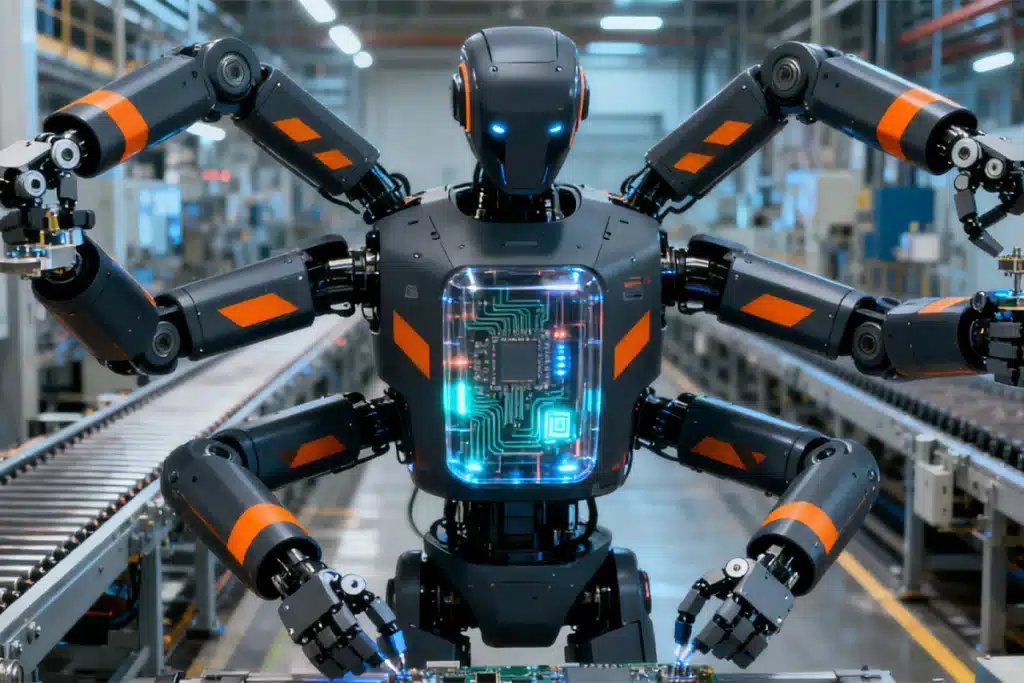
Robot arm components are the individual mechanical, transmission, and control elements that together create the articulated structure responsible for a robot's movement. Rather than functioning as independent parts, these components operate as an integrated system in which structural strength, motion control, sensing, and precision manufacturing all contribute to the robot's overall performance.
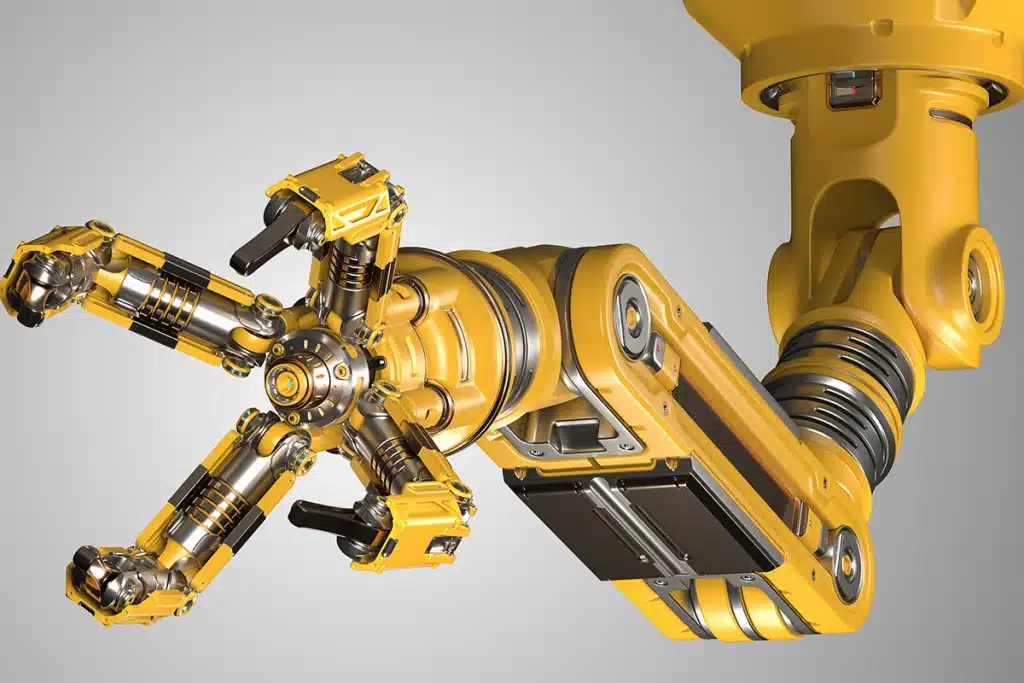
Although the exact configuration varies between industrial robots, collaborative robots, humanoid robots, and medical robotic systems, most robot arms share a common architecture. A typical robot arm consists of a rigid supporting structure, multiple rotational or linear joints, motion transmission assemblies, electrical and sensing devices, and an end effector that performs the desired task.
At a high level, robot arm components can be grouped into several major categories:
| Component Category | Primary Purpose |
|---|---|
| Structural Components | Form the mechanical framework and support external loads |
| Motion & Drive Components | Generate and transmit movement through each joint |
| Electrical & Control Components | Coordinate motion, communication, and power distribution |
| Sensors & Feedback Devices | Monitor position, force, speed, and environmental conditions |
| End Effector | Interact directly with workpieces or operating environments |
Each category plays a different role, yet none can function effectively in isolation. A lightweight arm structure cannot achieve high positioning accuracy without a rigid joint assembly, while an advanced servo system cannot deliver smooth motion if the mechanical components suffer from excessive backlash or poor alignment.
The overall performance of a robot arm is therefore determined not by a single component, but by how well every subsystem has been engineered to work together.
Robot Arm Structure and Kinematic Design
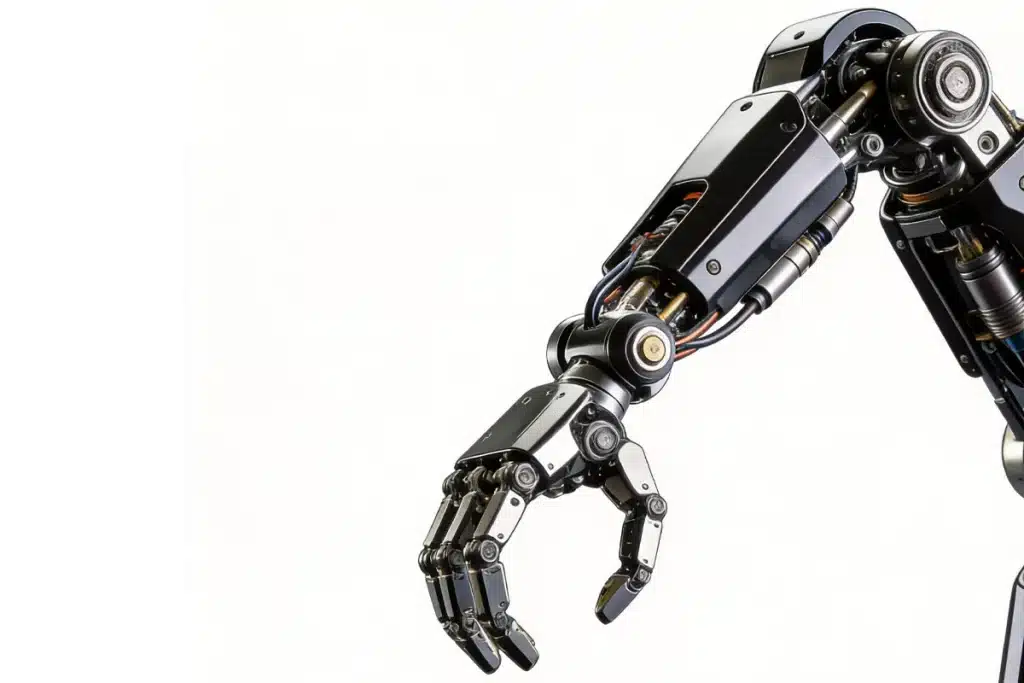
Unlike conventional machinery, a robot arm is designed as an articulated kinematic chain capable of reproducing movements similar to those of a human arm. Instead of relying on a single moving mechanism, the robot arm divides complex motion into multiple independent joints, allowing it to reach different positions and orientations within its working envelope.
Most industrial robot arms consist of a sequence of interconnected structural sections beginning with a rigid base and extending through several rotational joints before terminating at the wrist and tool interface. Each section contributes a specific degree of motion while simultaneously supporting the weight and dynamic loads generated by downstream components.
A simplified robot arm structure typically includes:
| Structural Section | Primary Function |
|---|---|
| Base | Supports the entire robot and provides a stable mounting platform |
| Shoulder | Generates the primary lifting movement and carries the highest structural loads |
| Upper Arm | Extends the robot's working reach while maintaining rigidity |
| Elbow | Increases workspace flexibility by introducing an additional rotational axis |
| Forearm | Transfers motion toward the wrist while reducing unnecessary weight |
| Wrist | Provides fine orientation adjustments for the end effector |
| Tool Flange | Connects the robot arm to grippers, welding torches, suction cups, or other tools |
The arrangement of these sections determines the robot's kinematic performance, including its reachable workspace, payload capacity, speed, and motion flexibility. Modern six-axis industrial robots balance structural stiffness with lightweight construction so that the arm can move quickly without sacrificing positioning accuracy.
In humanoid robots and collaborative robots, the structural layout also considers compactness, energy efficiency, and safe interaction with nearby operators.
Rather than being designed independently, every structural section influences the performance of adjacent components. Increasing the length of one arm segment, for example, expands the robot's reach but also changes the torque requirements of the drive system and increases the loads acting on bearings, shafts, and joint housings.
Successful robot arm design therefore requires mechanical structure, motion transmission, and control systems to be developed as a unified engineering solution.

Mechanical Components of a Robot Arm
The mechanical components form the physical foundation of every robot arm. Their primary responsibility is to support structural loads, maintain dimensional stability, transfer motion between joints, and ensure long-term reliability during continuous operation.
While electronic systems determine how a robot moves, the mechanical structure determines whether those movements remain accurate after millions of operating cycles.
Instead of treating every part equally, engineers usually divide the mechanical system into several functional groups based on the role each component plays within the arm assembly.
| Mechanical Component | Primary Function | Typical Design Focus |
|---|---|---|
| Structural Links | Connect adjacent joints and support external loads | Lightweight with high stiffness |
| Joint Housings | Enclose and support transmission assemblies | Dimensional accuracy and rigidity |
| Mounting Brackets | Secure motors, sensors, or auxiliary modules | Structural stability |
| Shafts | Transfer rotational torque between components | High concentricity and wear resistance |
| Bearing Seats | Position bearings and maintain alignment | Precision tolerances |
| Covers & Protective Panels | Protect internal assemblies from dust and impact | Low weight and serviceability |
Among these components, structural links and joint housings often represent the largest proportion of machined parts within a robot arm. They must remain rigid under dynamic loading while minimizing unnecessary mass, making lightweight structural optimization one of the most important aspects of robot arm engineering.
Rotating elements such as shafts and bearing seats demand even tighter manufacturing tolerances because slight geometric deviations can introduce vibration, reduce positioning accuracy, or shorten bearing life.
Meanwhile, mounting brackets and support structures are designed to distribute mechanical loads evenly throughout the assembly, preventing localized stress concentrations during rapid acceleration and deceleration.
Although these parts appear relatively simple when viewed individually, they collectively determine the robot arm's structural integrity, positioning stability, and service life.
High-performance robotic systems therefore place considerable emphasis on mechanical component design before electronic control or software optimization is ever considered.

How Robot Arm Components Work Together
A robot arm performs precise movements only because every component continuously exchanges mechanical forces, motion, and feedback with the others. From the moment a movement command is generated until the end effector reaches its target position, structural components, drive assemblies, sensors, and control electronics operate as one coordinated system rather than as independent modules.
The process typically begins when the controller calculates the desired trajectory. Servo motors then generate rotational motion, which is transmitted through reducers, shafts, and bearings to each joint.
As the joints rotate, structural links transfer these movements throughout the arm while maintaining sufficient rigidity to resist deformation under load. During the entire motion, encoders and sensors continuously monitor position, speed, and torque, sending real-time feedback to the controller so that any deviation can be corrected almost instantly.
This interaction creates a closed engineering system in which every subsystem influences overall performance.
| System | Primary Contribution |
|---|---|
| Structural Components | Support loads and maintain dimensional stability |
| Drive Components | Generate and transmit mechanical motion |
| Bearings & Shafts | Ensure smooth and accurate joint rotation |
| Sensors | Provide continuous motion feedback |
| Controller | Coordinates all movement and compensates for errors |
| End Effector | Executes the final manufacturing or handling task |
Because every subsystem depends on the others, improving a single component rarely guarantees better robot performance. A high-precision reducer cannot compensate for a flexible structural link, just as an advanced controller cannot eliminate positioning errors caused by poor bearing alignment or excessive structural deformation.
Modern robot arm engineering therefore focuses on optimizing the complete mechanical and control system rather than maximizing the performance of any individual component.
This system-level approach also explains why robot arm development requires close integration between structural design, precision manufacturing, assembly accuracy, and motion control.
Only when these disciplines are engineered together can a robot arm consistently deliver the speed, repeatability, and reliability expected in today's industrial and intelligent robotic applications.
Learn more about our robot arm components manufacturing capabilities , including precision machining, surface finishing, and prototype-to-production support for robotic applications.

Drive and Motion Components
If the mechanical structure forms the skeleton of a robot arm, the drive and motion system acts as its muscles and joints. These components generate motion, transmit torque, and precisely control every rotational movement, allowing the robot to position its end effector with remarkable speed and repeatability.
The performance of a robot arm is therefore determined not only by the strength of its structural components but also by the efficiency and precision of its motion transmission system.
Unlike conventional machinery that often relies on simple rotary shafts or linear actuators, robot arms require coordinated multi-axis motion. Every joint must accelerate, decelerate, and stop smoothly while maintaining synchronization with adjacent joints. To achieve this, multiple drive components operate together as an integrated motion system.
| Component | Primary Function | Typical Design Priorities |
|---|---|---|
| Servo Motor | Generates controlled rotational power | High torque density, fast response |
| Harmonic Reducer | Reduces speed while increasing torque | Near-zero backlash, high positioning accuracy |
| Planetary Gearbox | Transmits torque efficiently | Compact design, durability |
| Bearings | Support rotating assemblies | Low friction, long service life |
| Couplings | Connect rotating components | Misalignment compensation, torsional stiffness |
| Encoder | Measures joint position and speed | High resolution, real-time feedback |
Each component contributes to a different stage of the robot's movement. Servo motors produce the initial driving force, while reducers convert high-speed motor output into the low-speed, high-torque motion required by robotic joints.
Bearings support rotating shafts with minimal friction, ensuring smooth movement under continuous dynamic loading. Encoders continuously monitor angular position and rotational speed, providing the controller with the information needed to correct even the smallest deviations during operation.
The selection of drive components also varies depending on the robot's intended application. High-speed pick-and-place robots prioritize lightweight drive systems and rapid acceleration, while collaborative robots emphasize smooth motion and safety.
Humanoid robots often require compact, high-torque joint modules that integrate motors, reducers, encoders, and structural housings into a single assembly to maximize efficiency while minimizing size and weight.

Electrical and Control Components
Mechanical movement alone cannot make a robot intelligent. Every motion executed by a robot arm begins as a digital command processed by the control system before being translated into coordinated mechanical action.
Electrical and control components form the communication network of the robot, connecting sensors, actuators, safety devices, and software into a unified operating system.
Rather than functioning as isolated electronic devices, these components continuously exchange information throughout every stage of robot operation. Position data, motor feedback, force measurements, and external signals are collected, analyzed, and converted into precise control commands within milliseconds.
The electrical architecture of a modern robot arm typically consists of several interconnected subsystems:
| Subsystem | Purpose |
|---|---|
| Robot Controller | Executes motion planning and system coordination |
| Servo Drives | Convert control commands into motor output |
| Power Distribution System | Supplies stable electrical power to all modules |
| Communication Network | Enables high-speed data exchange between components |
| Safety Modules | Monitor emergency conditions and protect operators |
| Wiring & Cable Management | Deliver power and signals while allowing continuous joint movement |
Cable routing deserves particular attention in robot arm design. Every joint continuously rotates during operation, meaning cables must withstand repeated bending and twisting without affecting movement or signal stability.
Engineers often integrate internal cable channels, protective sleeves, or hollow shaft designs to improve reliability while maintaining a compact external appearance.
As robot systems become increasingly intelligent, electrical architectures continue to evolve toward higher integration.
Many modern joint modules combine motor drivers, encoders, sensors, and communication electronics into compact assemblies, reducing wiring complexity while improving overall system reliability and maintenance efficiency.
Materials Used for Robot Arm Components
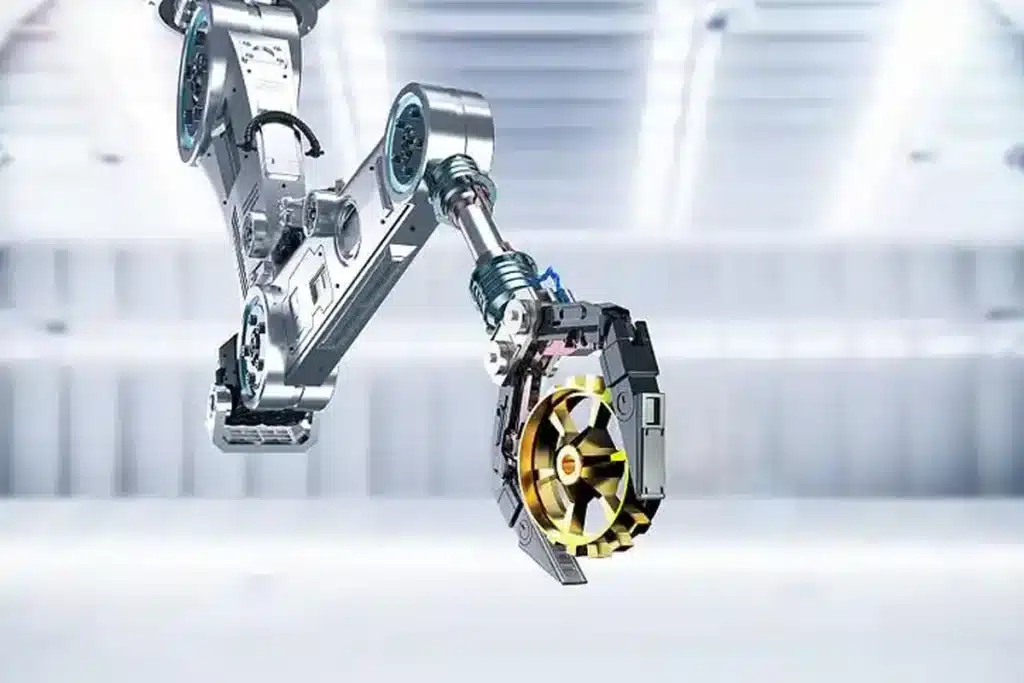
Material selection is one of the most influential decisions in robot arm engineering because it directly affects weight, stiffness, wear resistance, machining complexity, and overall system performance.
Instead of relying on a single material throughout the entire assembly, engineers select different materials according to the functional requirements of each component.
For example, structural links are typically optimized for lightweight construction to reduce inertia during acceleration, whereas shafts and bearing interfaces prioritize strength, hardness, and dimensional stability under continuous loading.
Protective covers, on the other hand, often emphasize corrosion resistance and reduced manufacturing cost rather than maximum mechanical strength.
The relationship between components and materials can be summarized as follows:
| Material | Common Applications | Why It Is Selected |
|---|---|---|
| Aluminum Alloys | Structural links, housings, mounting brackets | Lightweight, good machinability, corrosion resistance |
| Stainless Steel | Shafts, fasteners, bearing interfaces | High strength, wear resistance, corrosion protection |
| Titanium Alloys | High-performance joints, aerospace and medical robot components | Excellent strength-to-weight ratio |
| Engineering Plastics | Bushings, cable guides, protective covers | Low friction, electrical insulation, reduced weight |
| Carbon Fiber Composites | Lightweight structural members | Exceptional stiffness with minimal mass |
Material selection rarely depends on mechanical properties alone. Manufacturing methods, cost, operating environment, expected service life, and assembly requirements all influence the final decision.
Components subjected to repeated cyclic loading require excellent fatigue resistance, while parts operating in cleanroom or medical environments may require corrosion-resistant or biocompatible materials.
In collaborative robots and humanoid systems, reducing overall arm weight often becomes a primary design objective, making lightweight alloys and composite materials increasingly important.
Ultimately, successful material selection balances performance, manufacturability, and long-term reliability rather than maximizing any single material property.
How Robot Arm Components Are Manufactured
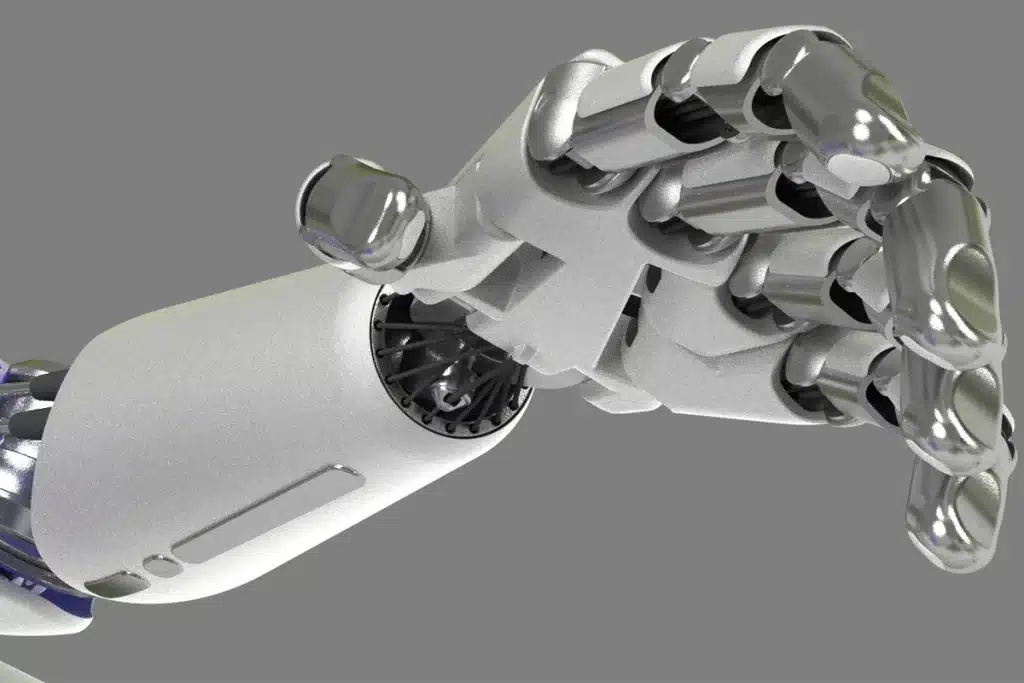
Modern robot arms are assembled from dozens or even hundreds of precision components, each manufactured using processes selected according to its geometry, tolerance requirements, and material characteristics.
Although production methods vary between individual parts, the overall manufacturing workflow follows a structured engineering process designed to ensure dimensional consistency and assembly accuracy.
A typical manufacturing sequence includes:
| Manufacturing Stage | Purpose |
|---|---|
| Engineering Design | Define geometry, tolerances, and functional requirements |
| Material Preparation | Select and prepare raw material for machining |
| Precision Machining | Produce complex structural and transmission components |
| Secondary Processing | Heat treatment, grinding, threading, or deburring as required |
| Surface Finishing | Improve corrosion resistance, wear resistance, and appearance |
| Inspection & Verification | Confirm dimensional accuracy and quality compliance |
| Final Assembly | Integrate mechanical and electrical components into joint modules |
Among these stages, precision machining plays the most significant role in producing robot arm components.
Structural links, joint housings, bearing seats, motor mounts, and numerous transmission parts are commonly manufactured through CNC milling, multi-axis machining, precision turning, and grinding processes to achieve the complex geometries and tight tolerances required by robotic systems.
Surface finishing represents another essential step rather than simply an aesthetic treatment.
Processes such as anodizing, electroless nickel plating, polishing, or hard coating improve corrosion resistance, reduce friction, increase surface hardness, and enhance the long-term durability of critical components operating under continuous mechanical stress.
Manufacturing does not conclude once individual parts are completed. Before entering final assembly, every critical component must undergo dimensional verification to ensure proper fit with mating parts.
Even minor deviations can accumulate throughout the robot arm, ultimately affecting positioning accuracy, motion smoothness, and service life.
From precision machining and surface finishing to inspection and assembly, every stage plays an important role in producing reliable robot arm components. Learn more about our Robot Arm Components Manufacturing capabilities and how we support robotic projects from prototype development to production.
Engineering Challenges in Robot Arm Component Manufacturing
Producing robot arm components involves far more than achieving dimensional accuracy. Modern robotic systems demand lightweight construction, high structural rigidity, long service life, and consistent repeatability—all of which place significant engineering demands on component design and manufacturing.
Many of these challenges are interconnected. Reducing weight, for example, often requires thinner wall sections or more aggressive material removal, yet both approaches may decrease structural stiffness or increase the risk of machining deformation.
Improving dynamic performance may require lighter moving assemblies, but those assemblies must still withstand continuous cyclic loading over millions of operating cycles.
Several engineering challenges are particularly common during the manufacturing of robot arm components:
| Engineering Challenge | Why It Matters |
|---|---|
| Lightweight Structural Design | Reduces inertia while maintaining sufficient stiffness |
| Thin-Wall Machining | Prevents deformation during precision machining |
| Tight Assembly Tolerances | Ensures accurate positioning of joints and transmission systems |
| Thermal Stability | Minimizes dimensional variation caused by temperature changes |
| Dynamic Balance | Reduces vibration during high-speed operation |
| Wear Resistance | Extends service life of rotating and sliding components |
| Surface Integrity | Improves fatigue performance and assembly quality |
Addressing these challenges requires close coordination between component design and manufacturing processes. Machining strategies must account for residual stress, fixture stability, and cutting forces to maintain dimensional consistency in lightweight structures.
Likewise, designers often optimize rib geometry, wall thickness, and material distribution to improve stiffness without introducing unnecessary mass.
As robot arms continue to evolve toward higher speeds, greater payloads, and more compact joint modules, manufacturing precision alone is no longer sufficient.
Success increasingly depends on integrating mechanical design, material engineering, machining technology, and quality control into a unified production strategy capable of delivering reliable performance throughout the robot's operational life.

Quality Requirements for Robot Arm Components
Precision is one of the defining characteristics of every modern robot arm. Regardless of whether a robot is assembling consumer electronics, welding automotive structures, or assisting in minimally invasive surgery, its performance ultimately depends on the consistency and quality of the components from which it is built.
Unlike conventional mechanical products, robot arm components must work together as a complete precision system. Small dimensional deviations that may be acceptable in general machinery can accumulate across multiple joints and transmission stages, leading to positioning errors, vibration, increased wear, or reduced service life.
For this reason, manufacturers evaluate robot arm components against a range of quality requirements that extend far beyond simple dimensional inspection.
Some of the most important quality characteristics include:
| Quality Requirement | Why It Matters |
|---|---|
| Dimensional Accuracy | Ensures correct fit between mating components and minimizes assembly errors. |
| Geometric Tolerances (GD&T) | Maintains concentricity, perpendicularity, flatness, and alignment throughout the mechanical system. |
| Surface Finish | Reduces friction, improves bearing performance, and enhances fatigue resistance. |
| Material Integrity | Confirms that mechanical properties remain consistent after machining and heat treatment. |
| Assembly Compatibility | Ensures components integrate smoothly without excessive adjustment during assembly. |
| Structural Reliability | Allows the robot arm to withstand repeated loading over millions of operating cycles. |
Quality verification is equally important throughout the production process. Critical dimensions are typically measured at multiple stages rather than only after final machining, allowing manufacturers to identify deviations before they affect downstream operations.
Functional inspections, assembly verification, and long-term reliability testing further ensure that the finished components perform as intended once integrated into the complete robotic system.
For high-performance robot arms, quality is not defined by a single inspection result. It is achieved through consistent engineering practices, controlled manufacturing processes, and rigorous verification from raw material to final assembly.

Applications of Robot Arm Components
Although the fundamental architecture of a robot arm remains largely consistent, the components used within different robotic systems are often optimized to meet very different operational requirements.
Factors such as payload, operating speed, environmental conditions, and required precision all influence the design, material selection, and manufacturing methods of individual components.
The following examples illustrate how robot arm components are adapted across major robotics applications.
| Application | Typical Requirements | Representative Components |
|---|---|---|
| Industrial Manufacturing | High payload, continuous operation, long service life | Structural links, heavy-duty joint housings, precision shafts |
| Collaborative Robots (Cobots) | Lightweight construction, safe human interaction | Compact joint modules, lightweight aluminum structures, integrated sensors |
| Humanoid Robots | High flexibility, compact joints, weight reduction | Modular actuators, lightweight links, miniature transmission components |
| Medical Robotics | Ultra-high precision, clean operating environment | Precision machined housings, stainless steel shafts, biocompatible components |
| Warehouse & Logistics | Fast repetitive movement, energy efficiency | Lightweight frames, durable bearings, compact drive assemblies |
| Inspection & Laboratory Robots | Smooth motion and positioning accuracy | Precision guide structures, compact actuators, vibration-resistant assemblies |
Despite these differences, the engineering priorities remain remarkably similar across industries. Every robot arm must maintain structural rigidity while minimizing weight, transmit motion accurately through multiple joints, and operate reliably under continuous cycles.
As robotic applications continue expanding into healthcare, logistics, agriculture, and consumer services, manufacturers are increasingly developing specialized component designs tailored to each operating environment.

Future Trends in Robot Arm Components
As robotic technology continues to advance, robot arm components are becoming lighter, more compact, and increasingly integrated.
Modern robot designs place greater emphasis on reducing moving mass while maintaining structural rigidity, leading to wider adoption of high-strength aluminum alloys, titanium, composite materials, and integrated joint modules that combine motors, reducers, encoders, and sensors into a single compact assembly.
These innovations improve motion efficiency, reduce energy consumption, and simplify system integration across industrial, collaborative, and humanoid robots.
At the same time, advances in precision manufacturing are enabling the production of more complex components with tighter tolerances and higher consistency.
Multi-axis CNC machining, automated inspection, digital quality control, and intelligent manufacturing technologies are making it possible to produce robot arm components that deliver greater accuracy, reliability, and long-term performance.
As robotics continues to expand into new industries, component design and manufacturing will remain key drivers of future robotic innovation.

Frequently Asked Questions
What are the main components of a robot arm?
A typical robot arm consists of structural components, drive and motion components, electrical and control systems, sensors, and an end effector. Together, these elements enable the robot to perform precise and repeatable movements.
What is the most important mechanical component in a robot arm?
There is no single most important component because every part contributes to overall performance. Structural links provide rigidity, joint housings support transmission systems, shafts transfer torque, and bearings ensure smooth motion. The robot's accuracy depends on how all of these components work together.
What materials are commonly used for robot arm components?
Robot arm components are commonly manufactured from aluminum alloys, stainless steel, titanium alloys, engineering plastics, and carbon fiber composites. Material selection depends on factors such as strength, weight, wear resistance, corrosion resistance, and manufacturing requirements.
How are robot arm components manufactured?
Most precision components are produced using CNC machining, multi-axis milling, precision turning, grinding, and other advanced manufacturing processes. Depending on the application, additional operations such as heat treatment, surface finishing, inspection, and assembly are also performed before integration into the complete robot arm.
Why is lightweight design important for robot arms?
Reducing the weight of moving components decreases inertia, improves acceleration and energy efficiency, and reduces the load placed on motors and transmission systems. Lightweight designs also help improve overall dynamic performance without compromising structural strength.
What are the biggest manufacturing challenges for robot arm components?
Common challenges include machining thin-wall structures without deformation, maintaining tight geometric tolerances, achieving consistent surface quality, ensuring accurate assembly, and balancing lightweight construction with sufficient structural rigidity.
How is the quality of robot arm components verified?
Quality is typically verified through dimensional inspection, geometric tolerance measurement (GD&T), surface finish evaluation, material verification, assembly testing, and functional validation. Critical components may also undergo fatigue or durability testing to ensure long-term reliability.
Why is precision so important in robot arm manufacturing?
Every joint in a robot arm contributes to the robot's final positioning accuracy. Even very small deviations in individual components can accumulate throughout the mechanical system, affecting repeatability, motion smoothness, and overall operational performance. High manufacturing precision is therefore essential for ensuring reliable and consistent robotic operation.